
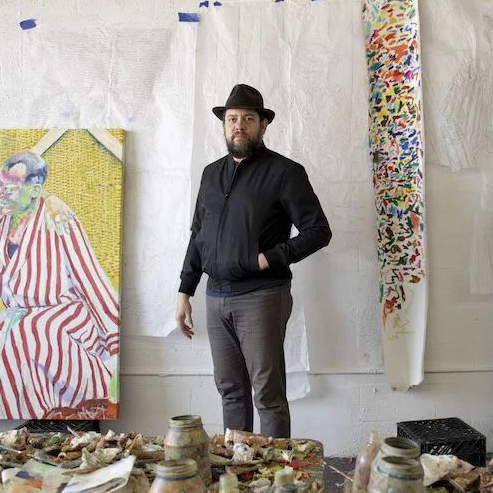
Farley Aguilar
0
0
基本信息
- 擅长
-
艺术家
- 性别
-
男
- 出生年月
-
1980年月
- 毕业院校
-
未知
个人简历
法利·阿吉拉尔,1980年出生于尼加拉瓜,是一位自学成才的艺术家,现生活和工作于美国迈阿密。1980年代中期,法利还年幼的时候,为了躲避战乱,阿吉拉尔一家移居美国。阿吉拉尔从历史照片中汲取灵感,用绘画探讨权力动态、群体心理、肤色歧视、种族、性别、童工、战争等议题。通过将作品建立在事实之上,阿吉拉尔在过去、现在与未来的社会政治现实之间架起桥梁。
阿吉拉尔用油画、油画棒和铅笔创作出一系列令人不安的作品。在平和的色彩与参差的图形碰撞中,阿吉拉尔不断挖掘历史的心理深度,人物从地上的一团噪音中跳脱出来,面孔是比肉身更具表现力和流动性的面具。
透过绘画,阿吉拉尔省思基本的社会平衡——看与被看、主体与客体以及(可能最重要的)个体与群体之间的关系,向观众展现了古往今来身体如何被当作社会动荡的燃点和症候。
Farley Aguilar (b. 1980) is a self-taught Nicaraguan artist living and working in Miami. Aguilar’s parents emigrated to the United States in the mid-1980s when he was a young child, fleeing the Contra War. Taking inspiration from historical photographs, he paints images that address power dynamics, group psychology, colorism, race, gender, child labor, incarceration, and war. By basing his compositions in fact, Aguilar bridges past, present, and future socio-political realities.
Using oil, oil sticks, and pencil to create unsettling compositions, Aguilar dredges the psychological depth of history with his placid pools of color that crash against jagged forms; figures spring from the scribbled noise of the ground and faces are masks more expressive and shifting than flesh itself.
Through the lens of his paintings, Aguilar meditates on fundamental social balances: the shift between seeing and being seen, between agency and objectification, and, perhaps most importantly, the relationship between the individual and the crowd. Aguilar shows how, throughout history, the body is scapegoated as the flashpoint and symptom of social turmoil.